Silver Antlers tells a distinct, specific story. It follows a small number of characters. There is conflict and a plot.
This is unusual for dark rides. From the early scary gag-style rides to that supreme production, Pirates of the Caribbean, narratives that employ the medium tend to follow a trend. Marc Davis, via Passport to Dreams, tells us about the latter:
[Walt Disney] didn’t like the idea of telling stories in this medium. It’s not a story telling medium. But it does give you experiences. You experience the idea of pirates. You don’t see a story that starts at the beginning and ends with, “By golly, they got the dirty dog.” It wasn’t that way.
The dark ride has almost always been treated more like documentary than drama. Even when Disney is adapting a well-known story—Peter Pan’s Flight, for example—the plot is whittled down to a few memorable scenes, frozen in time, and overlayed with relatively disconnected, easily-looped lines of dialogue (“Look out, Peter!” “Here we go!”). There is a beginning, middle, and end, but in the broadest strokes possible.
Marc Davis says it’s not a story telling medium, and Marc Davis has the resumé to speak with authority here, but I have to disagree. I understand the view: if theater evolved from conversation, then the dark ride evolved from nature. That is, an “organic,” spontaneously-occurring play is just a few people interacting with each other, and an organic dark ride is you moving through a space. An argument vs. a garden path. An argument rises and falls and eventually resolves. A garden path twists through a garden. (A blogger rambles.)
Even though it’s a stretch from the natural state of the medium, I’m confident that a coherent, specific story can be told like this. A dark ride can be like a safari but it can also be something like a picture book and a radio play combined into one 1. Very few works in the medium have tried this but it doesn’t mean that it can’t be done.
Will I be able to pull it off? I don’t know. But I think I can.
We’re going to talk about this idea some more on Monday, and next Monday, too. ↩︎
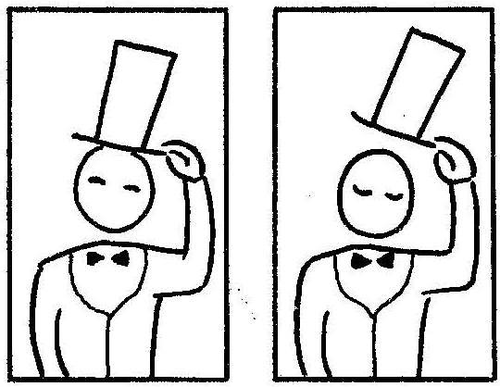
Action? Illustration by Scott McCloud in Understanding Comics
In my three semesters studying dramatic writing at NYU, I was constantly reminded of the importance of action in a narrative: instead of a character shouting “I am angry,” for example, it’s more effective to have that character, say, flip a table—she should perform an action that shows she is angry. An implication of emotion (or any other state) resonates more deeply with an audience.
The man in Silver Antlers is a passive protagonist. He doesn’t stop moving throughout the story, and in so doing he seems to miss all the good stuff: he asks the stag for a wish and by the time he gets home, the magic has already been cast and the wish has been granted. Again and again. This pattern is important to the story, but the problem is that the audience misses all the good stuff too. They see that things have changed, but they never see the change, because they’re following the man in and out of the woods.
I’m wondering if this is a problem. Will viewers get tired of this? Will their frustration serve constructively, to help them empathize with the protagonist? Will the subverted trope perhaps serve the story perfectly, given that it’s nearly impossible to show action of any kind with static dioramas?
Or am I perhaps interpreting the rule too literally? Just because I’m not presenting action doesn’t mean that action is not being perceived—the audience still sees (and hears, and feels) the changes in each scene, and those changes are significant.
In Understanding Comics, Scott McCloud discusses the concept of closure: a reader sees what happens in one panel and in the next, and is required to infer the action in the gutter. This is often a strength: what a reader imagines happening can be more vivid and exciting than anything that an artist could conceivably put to paper. As McCloud says, “To kill a man between panels is to condemn him to a thousand deaths.”
So is that my answer? Most of this “missing action” I’m worried about is a series of magical transitions that I probably couldn’t render in a very interesting manner anyway. Any sort of clever practical effect I might produce will never be as interesting as the images that flash through a viewer’s mind as she leaves the woods again and instead of seeing the man’s house, finds—well, you’ll see.