I’d like to divert our discussion today to talk about an aspect of themed design that we can’t use in Silver Antlers but is still an exciting and fascinating concept. A walk-through (or a dark ride) is meant to be experienced in exactly one way—even if there isn’t a plot in the sense we expect from a narrative work, there’s still a beginning, middle, and end to these things. But take a step back to the design of a collection of attractions and we’re building a land.
Compare “it’s a small world” to Fantasyland: the former is a single line (however much it may twist and turn) while the latter is a varied space, with many destinations that can be experienced or avoided at will. (I hope you never choose to avoid “small world.”) A land is built for wandering, and while it may also tell a story, it’s the kind of story that is definitely more felt than read: “Small world” suggests an idea but Fantasyland suggests a mood. It creates expectations in its audience so as to enhance whatever experience its individual attractions aim to share.
Lands can also be fractal: Fantasyland is part of the Magic Kingdom, which is part of Walt Disney World, and similar concepts are applied at different scales in each. We can think about the city of Lake Buena Vista as a land, too: it’s not as coherent as the others, because many more disconnected parties were involved in its design, but land design is not unlike urban planning.
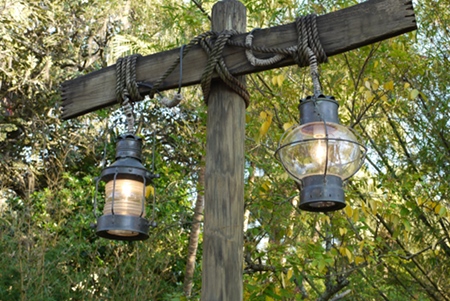
The Magic Kingdom is designed as a hub. There’s a large single entrance point: through the turnstiles, under the railroad station, and onto Main Street USA. But as we walk down Main Street toward Cinderella’s Castle1, the path branches off in many directions, toward Adventureland on the left, Tomorrowland on the right, and over the drawbridge to the other lands. Adjacent lands connect to each other as well, but they all stretch outward from the castle—spokes from the hub. The design was revolutionary when it was used to build Disneyland, and almost all of the Disney parks have used it since then. It’s a pattern that gently guides an audience from one destination to the next while helping them to maintain their sense of place. It also lends itself to subtle transitions, as the different lands tend toward equal proportions and repetition. I’ll refer you again to FoxxFur’s study of all of the lights in the Magic Kingdom for examples of how elegantly these lands can interact.
Speaking of Ms. Fur, let’s contrast the hub-and-spoke to the simple wheel design of World Showcase, the travelogue upper half of EPCOT at Walt Disney World. In Taking Apart World Showcase, she explains how the EPCOT planners made a very different decision in land design to great effect:
But the most exciting innovation is that all of these pavilions must be passed in order to get all the way around the lagoon: the hub concept for Disneyland, there a revolutionary gesture of convenience, here becomes a solid lake where once there was only a circular moat and links all of the civilizations to the original water from which they emerged from. The hub of Disneyland which offered both inclusion and exclusion (a spectator could visit Disneyland and never once enter Tomorrowland, for example) now is a wheel uniting all cultures in location in the geometric pattern of the globe they all share, a globe which is also the master layout of the sister area Future World and the icon of the collective entity known as EPCOT which they embody.
The important idea here is considering a land not just as a collection of attractions, but as an experience in itself. And land design can take cues from attraction design, as well: a land is experienced subliminally, but also slowly, and so there are plenty of opportunities to introduce elements of a story. Here’s FoxxFur in that same article explaining “false portals” (I told you we’d be referencing her research a lot):
A false portal can be a window, door, or any opening placed in any such way to suggest that any given themed space continues beyond where in reality it will stop [immediately] out of sight. Throughout Disney parks there are false doors, false windows, false caves, false skylights, false rivers, false balconies, and practically anything which can be reasonably built to suggest that regular human activity is going on in the theme park, one of the least accommodating areas for regular human activity ever devised. The spectator isn’t trained to look at the theme environment as being built for the express purpose of selling an idea to them; they look at it as they would any real life environment where things are where they are because that’s where they were built, and as a result the aim of Stratification is achieved subliminally.
(“Stratification” used in the context of themed design essentially means the act of creating a believably natural environment. Read more about Stratification versus Presentationalism in Elements of Theme Design, an article whose author should be obvious by now.)
So a land is, at least in its most popular form, a collection of attractions arranged deliberately to complement each other, as well as the spaces used to move between them, all of which attempt to imply a consistent universe. And I use the term “attraction” very loosely.
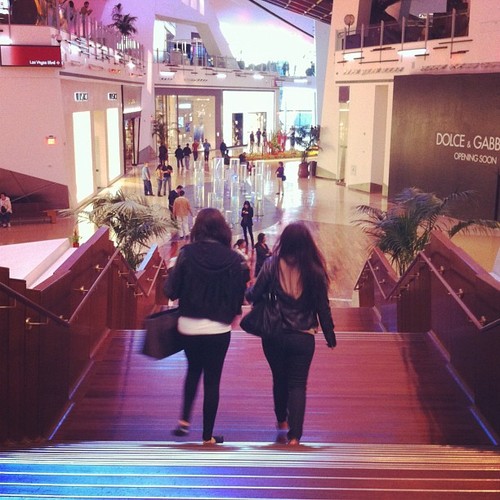
A view of Crystals at CityCenter in Las Vegas
CityCenter is a huge complex that opened in Las Vegas a few years ago. It’s one of the most ambitious projects on the Strip. A hotel and casino, another hotel or two, some condominium towers, and Crystals, a shopping mall. Maybe my favorite shopping mall ever. Its layout is nothing like Disneyland—the map looks pretty similar to any mall’s map—but the level of detail is astounding. Each storefront was carefully and specifically designed to complement and coordinate with the retailer it represents, from the materials and lights used in its façade right down to the style of its doors. The stores tend to jar and there’s no sense that Crystals is, say, a town square inhabited by local residents2, but the contrast is very pleasing and there’s a sense of consistency despite its lack of sameness. If you’re looking for an application of themed design outside of experimental theater, you’ve got it here.
I want to use all of these ideas but they’re just too big for Silver Antlers. I plan to add some false portals and little tricks like forced perspective3 into the castle scene, but I’m thinking about ways to incorporate these strategies into our next project in a bigger way. Do you happen to know someone who’s building a mall?
The castle serves Main Street as what Walt called a weenie: a large focal point in the distance that draws an audience onward to a specific destination. ↩︎
A common example of forced perspective is designing an inaccessible second story of a show building at less than life scale, so the structure seems larger than it really is. Disney parks are overflowing with these touches, which integrate naturally with false portals and things like fake staircases, to create the illusion that an environment is busier and larger than it really is. This flavor of misdirection is all over Las Vegas, too—casinos avoid straight sightlines so their inhabitants always feel like there’s something more to see just around the bend. ↩︎
The man returns to the clearing where he spared the stag. By the middle of the night, he has finally found the animal again.
“Excuse me,” he says, feeling a bit silly. “My wife–we think that maybe you can grant us a wish? I was supposed to provide a wonderful feast for my wife’s birthday this morning, and helping you–I wasn’t able to provide for her. If you’re able, can you help us have a happy day?”
The stag stares at him, and he’s sure that this whole idea was a foolish dead end, when he notices something that wasn’t there before: a lantern in his right hand.
“What is–did you do this? Does this mean you’ll help us? Have you already?”
The creature’s gaze never breaks, but somehow the man knows that the deed has already been done.
“Okay! Thank you? Thank you!”
With a new lantern to guide him, he rushes back home.
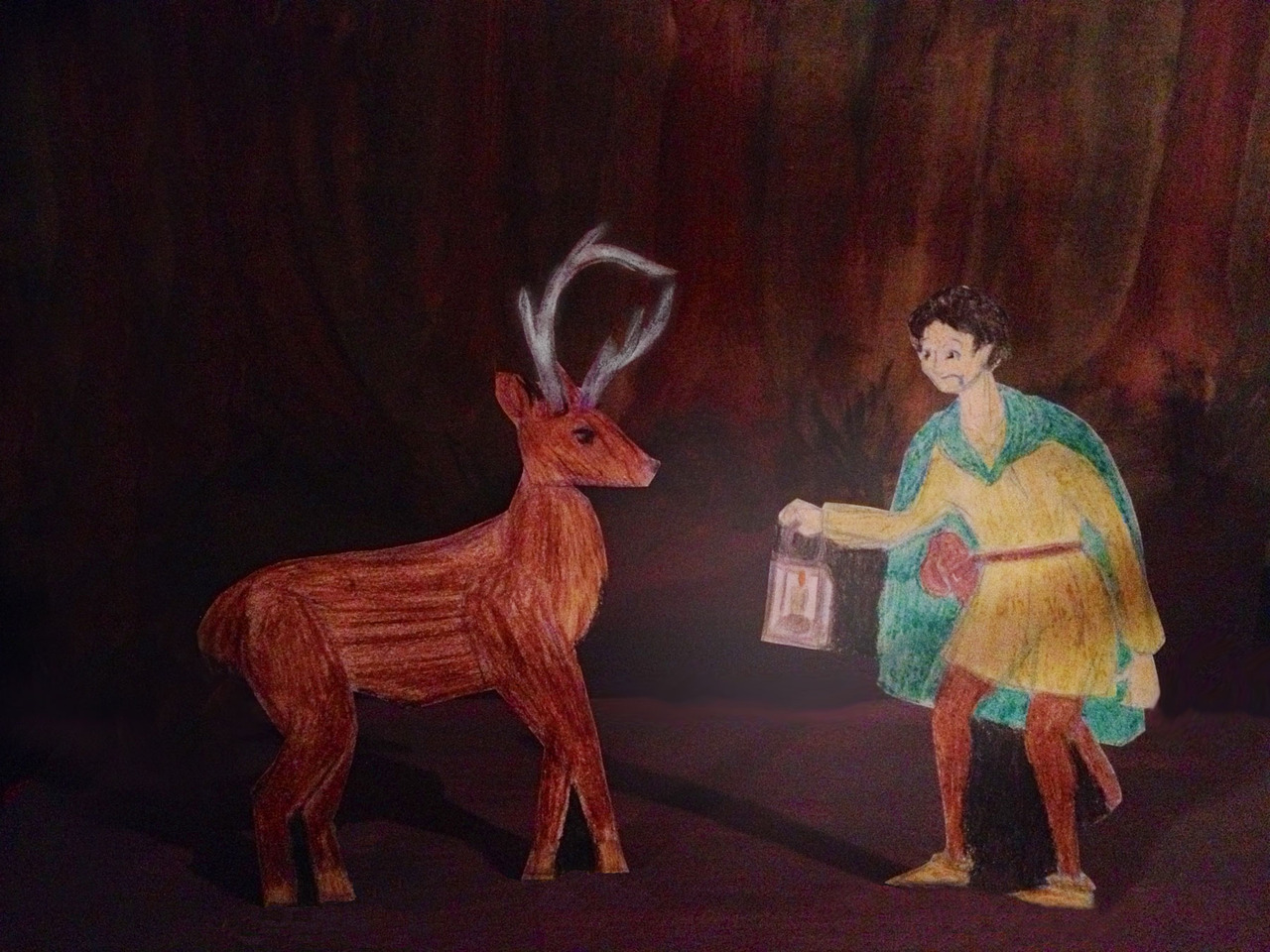
We’re getting closer now and it feels wonderful. This is a little diorama I put together with my friend Zander, who will serve (is already serving) as the technical lead on this production. This is the first time that any part of the Antlers story has been presented with depth. It’s simple for now, just a little prototype–crayon on cut-out paper with a simple painted plywood set–but it’s the tiniest taste of what’s to come. I drew and assembled the characters. Zander saw me doing this, disappeared for a little while, and returned with an utterly lovely painted forest backdrop. When we assembled the scene and arranged the lights just so and took a photo, this all finally felt real.
We have a long way to go, of course. These characters are about 11" tall and flat; the characters in the final version of this scene (I hope!) will stand a few feet tall in three dimensions, and they’ll move. The stag’s head will bob ever so slightly; the man’s arms will be at his sides, and when he feels the lantern appear in his hand, he’ll raise it, and it will light up just perfectly on cue.
When we were talking about all the media that the story of Silver Antlers could fit, I mentioned a radio play. A radio play is (and I’m being unfairly general here but stick with me) a movie we watch with our eyes closed. Of course there are certain parts of a story that we can only perceive with our eyes—things like body language—but there are ways to compensate for most of those with words and other sounds.
And that hindrance can also be a boon. If we’re only using our ears to take in a story, we’re paying more attention to what it sounds like than if we were also processing visual information. And with more attention on the words, it can be easier to let the writing grow a few flowers.
A novel, a radio play, a stage play, and a film slide from least to most fully realized before consumption by the audience. Let’s compare:
A novel’s events unfold entirely in the mind of the audience, and while novels frequently contain dialogue, they also contain written descriptions of the scenery and action of a story. A novel can succeed without any dialogue at all–perhaps unfolding entirely in the mind of the protagonist, if you will.
A radio play is heard, rather than read. A radio play can be little more than a book read aloud—the medium is related closely enough to the novel that its stories can also eschew dialogue, favoring dictation by a narrator—but a general use of the medium involves multiple actors playing different roles, and sound effects and music to imply action and scenery.
A play is tangible: the audience hears the cast deliver their own lines, like a radio play, but they also watch the cast interact: another layer of information. Narration is unlikely and scenery is often just implied (a restraint caused by all the action being limited to the physical constraints of a stage), but the dialogue tends to be dense and the physical gestures grand to compensate.
A film also has tangible actors and audible dialogue, but there’s also far more motion in the audience’s point of view than when they are watching a stage, as the film is captured by a camera that can move anywhere, and shots can cut in and out at will. Scenery rarely needs to be implied and backstory is most often presented in dialogue (or subtext, or not at all)–narration tends to be rare.
Given that list, where do we fit, and what kind of text can we get away with? We have a visual component, but it’s largely static–there’s very little information available in the way of body language. The audience can move like a camera but save for scene breaks, the visual information they’re receiving won’t really change. The cast’s lines will be delivered by a voice outside of the viewer’s imagination, but it will still effectively be disembodied, like a radio play.
It’s an equation that I’ve yet to balance. I’m torn between lush, descriptive narration coupled with simple dialogue (which turns out to be about a minute per scene) and more expressive dialogue with no narration (which is quicker). I’m leaning toward the latter, but I don’t think there’s a right answer here.
I haven’t said all I wanted to say about this topic and my thoughts are fairly unorganized, but this is a good view of how these decisions are relating to each other in my mind. I’ve chosen to ignore silent films (and silent plays) for now, as well as graphic novels (and illustrated books), because this spread is already complicated enough, but they’re important points on the (line? graph? form?) we’re plotting. I’ll come back to this after I’ve made some more decisions, and I’d love to know how you feel about the arrangement as well.
Perhaps my most favorite element of the soundtrack for a walkthrough is the freedom of multi-channel audio. Surround sound has been used in movie theaters for decades and many of us even have 5.1 audio in our homes, but a walkthrough’s speaker arrangement is built specifically and exclusively for the scene at hand and can get delightfully complex. There can be a speaker in a character’s mouth that only plays her dialogue. There can be a speaker in a stream that only plays burbling water.
The decisions we make here depend on the decisions we make in our previous step (if there is narration then we probably need speakers overhead in each scene) as well as our scale (in our smallest iteration, the one where the scenes are lit in sequence in a single room, we might have one speaker per scene and one in the center of the space for non-diegetic sound).
These ideas deserve their own post, which you’ll read next week. This week we’re talking about some specifics of the arrangement and layout of our show in my ideal conditions, and we’ll also work out a proper timeline to make this thing real. And of course you’ll see a preview of the next scene. But you won’t hear anything. Yet.
Happy Thanksgiving if you live somewhere that celebrated the holiday yesterday. I sure did, and I still can hardly move, so here’s a simple post for the weekend: a list of all of the things that this production requires, broken down by scene. This list already exists in my head but this is the first time I’m writing it down. It will be very useful.
General notes
Every scene but 6 takes place in the woods–lots of trees and brush throughout.
The man wears a cloak over a tunic and tights; the woman wears a loose-fitting dress. They have very similar plain leather shoes.
Depending on scale, the stag’s antlers will have a dedicated lighting effect that needs to be controlled in each appearance
If we add motion, all characters will need to be rigged and will require one motor each
Scene 1
Man, arms raised over head with bow and quiver
Stag, on hind legs
(Non-background) tree with shaker motor (?)
Scene 2
Wife, arms outstretched, one hand pointing, shouting face
Man, sheepish with bow and quiver
Hut/hovel
Scene 3
Man, leaning forward with lantern (controllable light) in upstage hand, probably without bow or quiver (he left them at home?)
Stag, standing elegantly
Scene 4
Woman, chicken in downstage arm, long list in upstage hand
Man, defeated pose, with lantern in same hand as scene 3
Scene 5
Man, in reverence (almost crouched), holding list from scene 4 in upstage hand
Stag, leaning forward to read the list
Royal horse and carriage (with lighting effect?)
Scene 6
Woman with tall crown on tall throne, angry, leaning forward and pointing
Man, looking upwards at throne, frightened, pleading
Armed guard holding man by the elbow
Long banquet table: turkey, goblets, platters of food
Stone brick walls, tapestries
Various attendants, guards, maidens, etc., not animated (or animated as a whole), possibly abstracted
Scene 7
Man, muddy, wet, begging
Stag, ferocious, back arched, antlers lit a different color
Second stag to be used for effect on hind legs
Fire effect in background
Practical effect for lightning strike?
Scene 8
Man with torch
You’ll see what else.
On Monday we’re going to talk about our soundtrack choices on a theory level: narration, dialogue, music, and sound effects. After Monday, we’re getting technical, and I’m so excited for it.
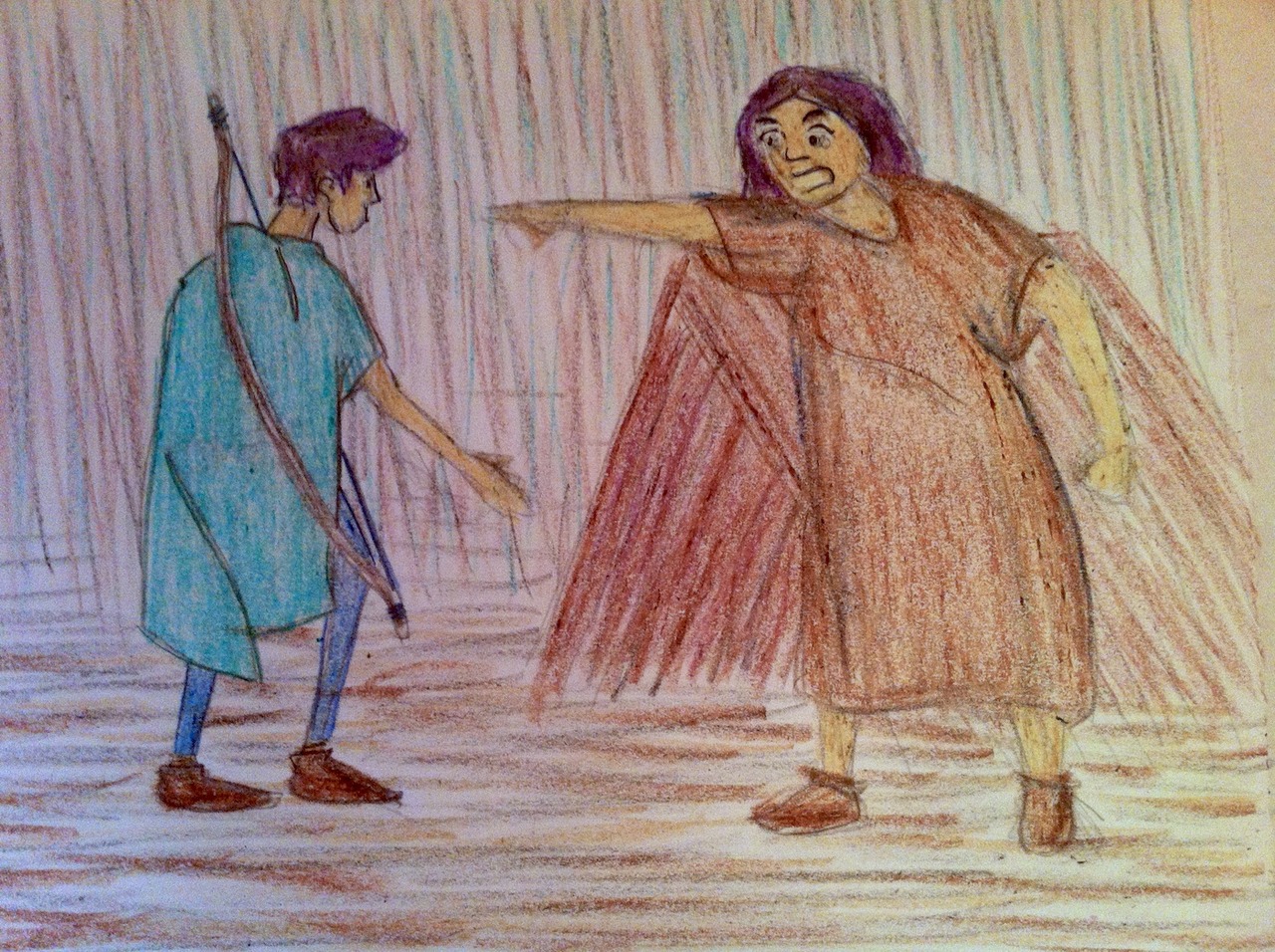
We meet the wife. She’s excited to see what her husband has caught her for her birthday, but he returns sheepish and empty-handed. Maybe a little scared. He explains that he did find an excellent deer, but he just couldn’t take its life. He explains its sparkling silver antlers and is sure she’ll think he’s just making up an excuse. She gets even more upset, but even after all the ways he imagined this exchange happening, her response catches him by surprise.
Did it grant you a wish? A wish?
She explains that if a stag has silver antlers, then it must also have magical powers. (This makes sense.) She sends him back out into the woods to find this magical stag and to make it grant her a birthday wish more grand than anything he could have done before.
There are some leaps between this scene and the introduction, which I showed you last week. He’s a hunter now, and it’s his wife’s birthday, both of which changed on Thursday. This one’s in color, too–I’d like to increase the fidelity of each scene I share, little by little, as we continue into production. This time it’s crayon. Next time, maybe a little dimension.
Layout-wise, this scene happens quickly after the last. If our scale is as great as I imagine, the first two scenes will share one large space: the first right in front of you as you enter, and the second to your right, and a bit back. As scene one ends, you’ll hear the wife calling out to her husband behind you, you’ll turn and see a light on her, and as the man approaches, his model in that scene also lights up.
The scenes leaving the stag will always occur more quickly than the scenes approaching it–it’s the same distance for him to travel, but he’s always more excited to head home, and so the trip feels shorter to him (and is shorter to us).
Also, in every scene with his wife, his back is to us. This is bad in theater, but in a dark ride it’s not such a big deal–the audience will be able to walk around very close to the scene (but not in it; please don’t touch the models) and so our blocking can be a little more flexible.
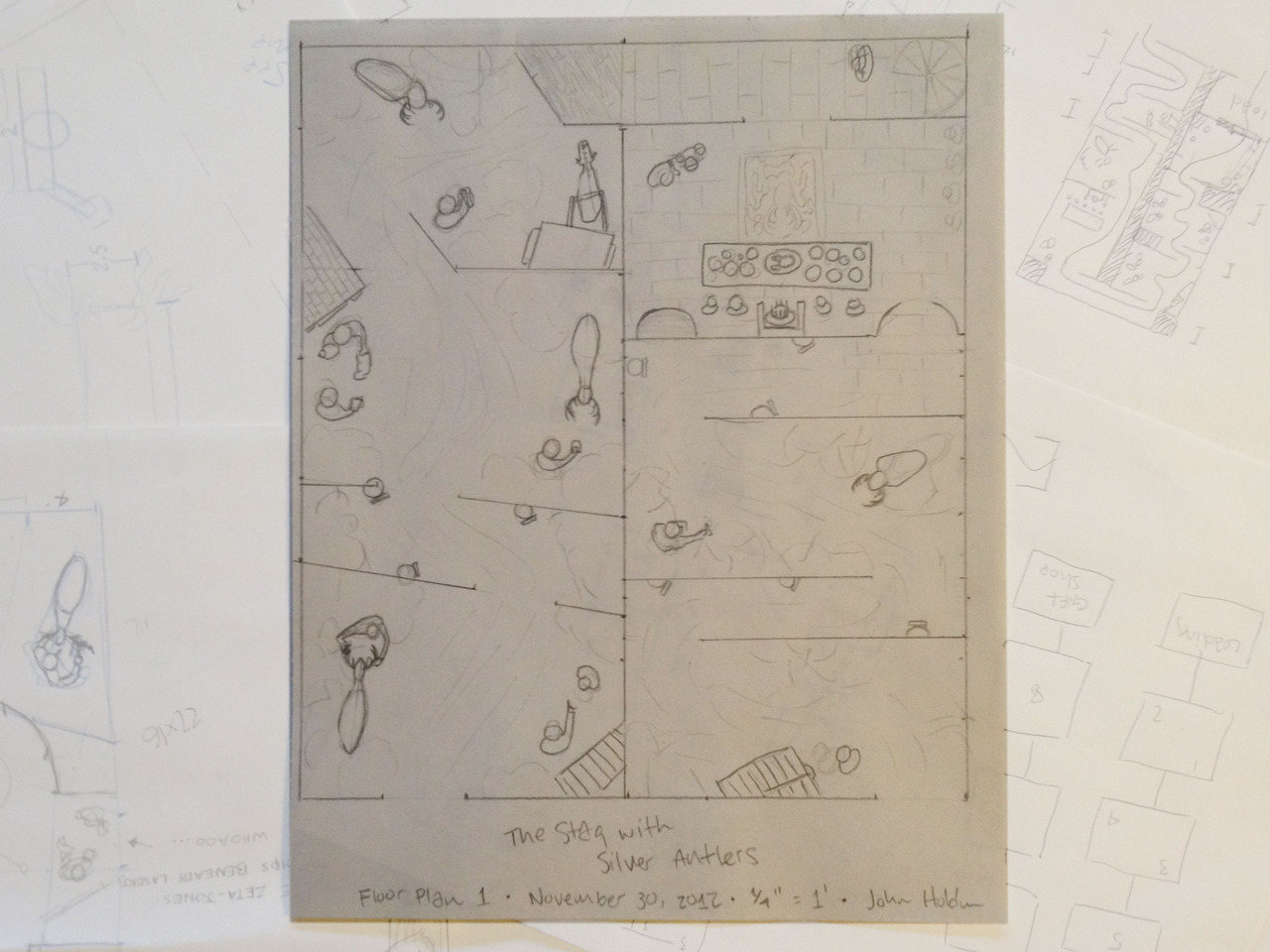
I’ve drawn too many flow charts and diagrams for the show to count, but this is the first time that I’ve paid attention to scale, measured rooms and visualized effects, held my arms above my head to figure out the right antler sizes, and put ruler to paper. This is an accurate floor plan. It all fits, it all makes sense.
The show is about 35-40 feet per side–the drawing is accurate but not necessarily specific. The spaces between the figures and scenes will be mostly felt out given the real space, which I can now start searching for more seriously, since I know what I’d like to land.
The doors and transition halls are about four feet wide, and the stag stands 6-7 feet tall (including those silver antlers). It’s designed for groups of four to eight people to experience as a group (with an attendant) with up to three groups moving throughout the show at once. Many of the scenes share a room–for example, as the first scene (in the bottom left room) ends, the second scene begins, and the group merely needs to pivot in place. All of the hallways except for the one at the midpoint (upper right) indicate a journey back into the woods. I described this idea a little more specifically in the explanation of the second scene.
To prevent light and sound leaks, the rooms run alternately–that is, when either of the scenes in room 2 (middle left) is live, the rest of the lights in the rooms on the left half of the space are dark. Since there’s so little buffer space, we do this to prevent light and sound leaks1. If you’re in the opening room, I don’t want you to hear what’s going on just ahead of you or be distracted by lights coming down that hallway. There’s an added benefit, too: if I can get cues to sync properly, we can double up some of the switches–a single light may turn on in an otherwise empty room if it means it can share a dimmer with a light in an active room. We’ll talk about all of this in much more detail at the end of next week, in our big discussion on lights.
This plan is intentionally unlabeled–I still don’t want to give too much away yet. Even after you’ve seen all the scene previews, there are some touches that won’t be apparent until you’re walking through the real thing. But I want you to see this so you have a better idea of what’s walking around in my mind, and so you can get as excited as I am!
Tomorrow we’ll talk about some logistics for the rest of the project, and on Monday I have a huge essay for you about something that won’t come into play on this show, but will certainly make it into our next one, and is exciting to talk about: designing a Land.
The wall running vertically up and down the center of the space will be dampened significantly, since there’s no good way to keep horizontally-adjacent rooms apart. ↩︎
Silver Antlers is a very simple story. There are eight scenes which alternate between two locations. There are three characters, only two of which are in any given scene, and very few props. When I think about the story, I picture it in many different ways: a walkthrough. A dark ride. A stageplay. A film. A radio play. An illustrated book. A graphic novel. An album. How can I choose just one medium?1
We’ve already decided that this will be a walkthrough, but even with that chosen, there is lots of freedom. How large will the models be? Will we create full, three-dimensional figures, or “2.5-D” flats, like a pop-up book? Will the scenes be life size? How close in space will they be to each other? Should the guests travel through corridors between scenes, or maybe we’ll put them all in one large space and light them in sequence?
You can probably guess that I’ve imagined every possible combination of these options and more. The absolute simplest incarnation that could possibly satisfy me would be lightbox-style scenes, a few feet wide and maybe six inches deep, arranged in sequence on a long wall. There would be no special light cues—each box might have some small special effects inside it, but the whole space would be lit uniformly. Think of the way paintings are traditionally presented in an art gallery. The narrative would either be played from a small speaker close to each piece or simply written out and mounted on the wall. This would work, but it wouldn’t be too impressive.
The amazing, world-shattering, best-case-scenario-and-then some version would be life-size models in life-size settings, each fitted with its own speaker for an accurate sonic image. They would be space apart by a walk long enough for a bit of music, so that the viewers truly feel the protagonist’s journey. The lights would be cued both to the viewers’ presence and the story: lights up as a scene comes into view, lights down as it ends, and plenty of other effects to represent weather and narrative beats. The characters would also move—not full animatronics, but a head turning here, an arm lifting there. This would be incredible.
Note that even in my wildest dreams, Silver Antlers is not seen from a cart. I love vehicle-based dark rides but they don’t suit this story. It’s all about walking through the woods. I want you to walk through the woods with the characters2.
Where do we settle between these two ends of our spectrum? The issue, of course, is money. I’m making a personal investment in this project, and I hope to charge admission as well. (It’ll be modest.) It just comes down to how excited you are. If you’re as excited as me then we’re going to make the big version, no problem. But I can’t know that yet. Yes, there will be a Kickstarter. Soon.
I’ve been looking at event spaces for rent in New York City (where I live). I’ve been pricing lighting equipment and art supplies. I’ve been sliding scale models around. I’m still working on what I think will be a reasonable goal.
Even if my project isn’t backed, this is still going to be real. One of my first middle-of-the-spectrum arrangements is a relatively cheap fallback:
Imagine a space about 12’×16’ with an entrance in the center of one of the short sides. In the center of the space is a large surface, about 4’ square. This is the woods. All four woods scenes will be staged here, as 1:5 scale models, with only one visible per edge of the surface. The other four scenes are flats, mounted one on each wall. Speakers and lights will be threaded in throughout the space and as the soundtrack plays, lights will focus on the scenes in sequence. Rather than a continuous stream of viewers, the work will be experienced by one (small!) group at a time.
Can you see it? That space is my apartment. I want something more grand but one way or another, The Stag with Silver Antlers will be.
We’re going to keep thinking about this as if it’s the full-scale version, both for optimism’s sake and also to figure out just exactly what we’re getting into. The story is fairly set by now, so our conversations are going to start leaning more technically. Next week we’ll talk about our options for the soundtrack. Sound hardly takes up any space at all, so if there’s any sound at all, it’s going to be wonderful.
I’m not choosing just one, but we’ll get to that later. ↩︎
Silver Antlers tells a distinct, specific story. It follows a small number of characters. There is conflict and a plot.
This is unusual for dark rides. From the early scary gag-style rides to that supreme production, Pirates of the Caribbean, narratives that employ the medium tend to follow a trend. Marc Davis, via Passport to Dreams, tells us about the latter:
[Walt Disney] didn’t like the idea of telling stories in this medium. It’s not a story telling medium. But it does give you experiences. You experience the idea of pirates. You don’t see a story that starts at the beginning and ends with, “By golly, they got the dirty dog.” It wasn’t that way.
The dark ride has almost always been treated more like documentary than drama. Even when Disney is adapting a well-known story—Peter Pan’s Flight, for example—the plot is whittled down to a few memorable scenes, frozen in time, and overlayed with relatively disconnected, easily-looped lines of dialogue (“Look out, Peter!” “Here we go!”). There is a beginning, middle, and end, but in the broadest strokes possible.
Marc Davis says it’s not a story telling medium, and Marc Davis has the resumé to speak with authority here, but I have to disagree. I understand the view: if theater evolved from conversation, then the dark ride evolved from nature. That is, an “organic,” spontaneously-occurring play is just a few people interacting with each other, and an organic dark ride is you moving through a space. An argument vs. a garden path. An argument rises and falls and eventually resolves. A garden path twists through a garden. (A blogger rambles.)
Even though it’s a stretch from the natural state of the medium, I’m confident that a coherent, specific story can be told like this. A dark ride can be like a safari but it can also be something like a picture book and a radio play combined into one 1. Very few works in the medium have tried this but it doesn’t mean that it can’t be done.
Will I be able to pull it off? I don’t know. But I think I can.
We’re going to talk about this idea some more on Monday, and next Monday, too. ↩︎
The scene I showed you yesterday, as of last night, has changed.
I started telling the Antlers story to a friend. I was describing the first scene when we were interrupted by something—a waitress bringing us our drinks, probably—and after a quick “cheers,” he said, “So the man is hunting the stag, and then what?”
I hadn’t said he was hunting the stag, but…of course he was! The way I saw the story, he’s merely gathering fruits and vegetables to bring home, and in helping the stag, his food is trampled: his kind deed brought him misfortune. But the events are rather unrelated, and implausible: why would be put his day’s work so close to the deer’s hooves? It also doesn’t really follow that his wife would be so upset after he lost only a few hours’ worth of work that she would immediately send him out to find more.
But if he’s hunting, a lot of these points become more clear. First, he’s not just collecting food for that evening—surely they have some means of doing that on a regular basis, and have a bit of produce stocked at home. This is a special occasion. He’s hunting for a feast. A gift for his wife. And they’re very poor, so they can’t afford to keep a horse or a hound, which were all but necessary when hunting large game in the middle ages (which is roughly when this story is supposed to take place). So his hopes were low, but he was out there, trying, stalking around with his bow, trying to make something happen.
Then there’s this deer with his antlers caught in some branches. It doesn’t notice him, it’s not going anywhere, and it’s enormous. Perfect!
For the man to let this thing go is huge. Whether it’s because he feels wrong killing a helpless creature, or because he’s scared of the aura around it, or because he just finds those silver antlers fascinating: that goes unexplained. It’s up to you to decide. But suddenly there’s something to decide here! There’s emotional conflict! It’s not just things happening!
I’m so glad that waitress showed up.
I’m researching how people hunted in the middle ages, to figure out how this works. (That’s how I knew about the horse and hound thing.) I know now that the man has a bow, which is awesome. I learned the word hart, which is a name for an adult male red deer, the kind most suitable and honorable for hunting. I’m learning about hunting traditions, like how big honor’s role was in the practice. And I found Saint Eustace.
I had heard his name before, but I didn’t know his story. Here’s the exciting bit of Saint Eustace’s hagiography, written by Jacobus de Voragine in The Golden Legend in the 13th century:
So on a day, as he was on hunting, he found an herd of harts, among whom he saw one more fair and greater than the other, which departed from the company and sprang into the thickest of the forest. And the other knights ran after the other harts, but Placidus siewed him with all his might, and enforced to take him. And when the hart saw that he followed with all his power, at the last he went up on a high rock, and Placidus approaching nigh, thought in his mind how he might take him. And as he beheld and considered the hart diligently, he saw between his horns the form of the holy cross shining more clear than the sun, and the image of Christ, which by the mouth of the hart, like as sometime Balaam by the ass, spake to him, saying: Placidus, wherefore followest me hither? I am appeared to thee in this beast for the grace of thee. I am Jesu Christ, whom thou honourest ignorantly, thy alms be ascended up tofore me, and therefore I come hither so that by this hart that thou huntest I may hunt thee.
Cool. (Here’s the whole story if you’re piqued.) I don’t want Silver Antlers to be a tale steeped in Christianity, but there’s exciting potential in this story that I might be able to incorporate.
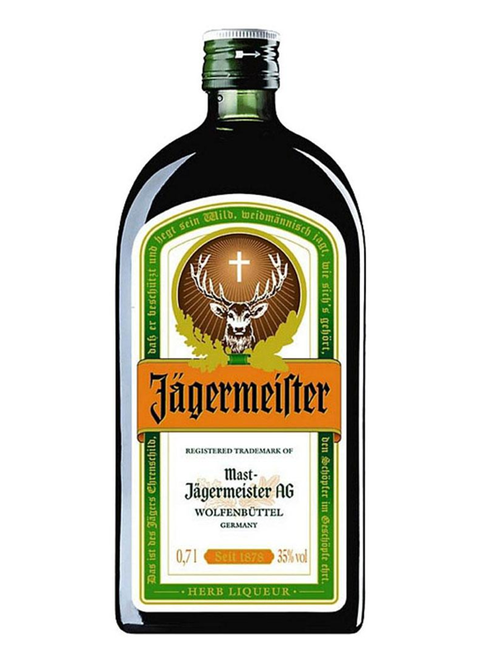
And the next time I’m at that bar, I think I’ll have some Jägermeister.
Can anyone put me in touch with Mast-Jägermeister SE’s promotional department? I smell a sponsorship.
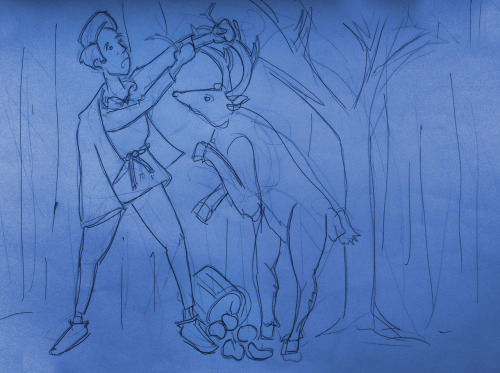
Here’s an illustration of the first scene in Silver Antlers. We meet the stag in a place of…maybe not hardship, but frustration, definitely. We meet the man who stops on his way home at the end of the day to help the stag free his silver antlers from the snarled brush, sacrificing the day’s gatherings, leaving him and his wife without supper. Hopefully, one way or another, the man’s kindness will pay off. We’ll see.
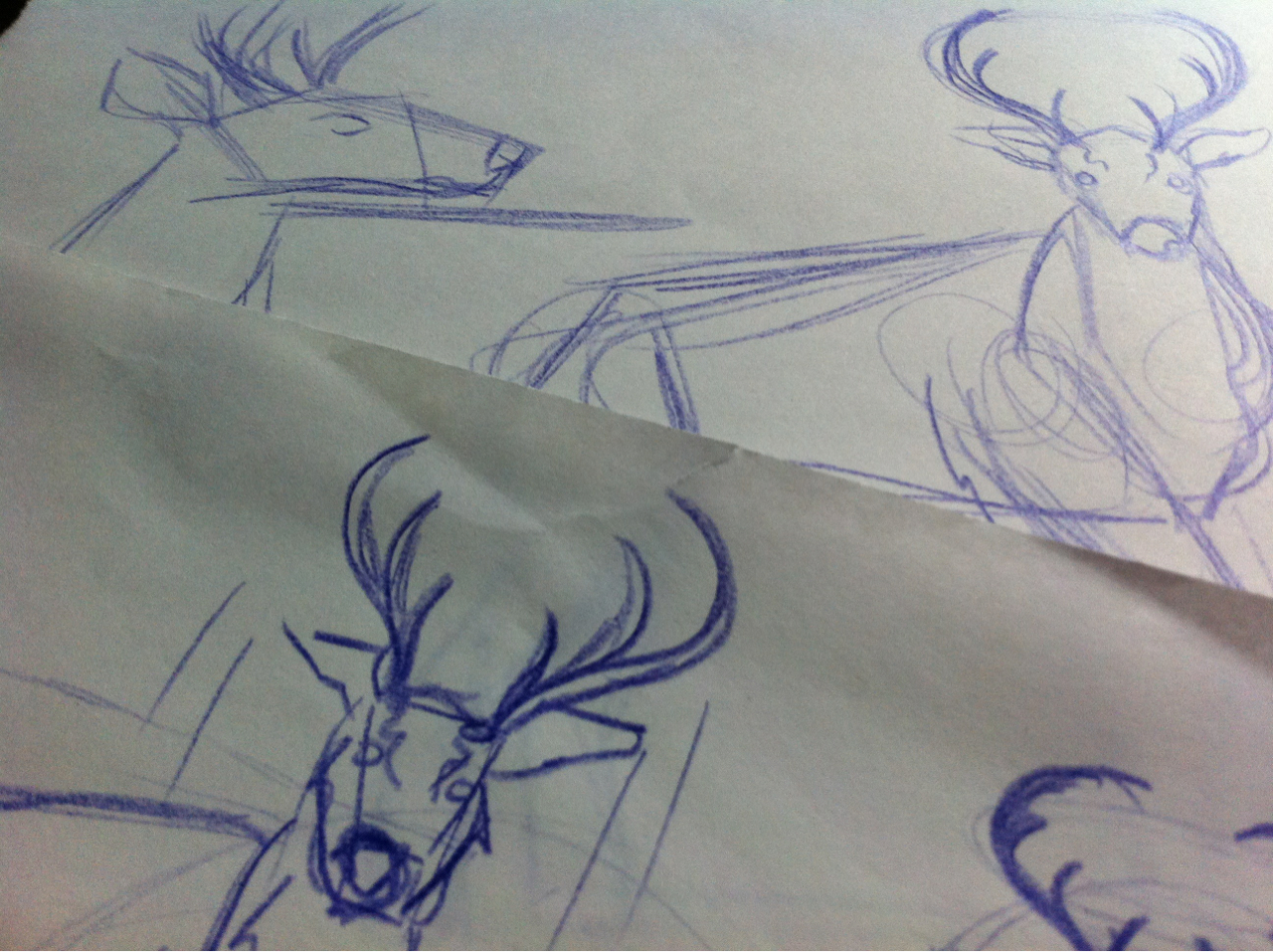
I drew this scene and the rest of the show very quickly the night I picked this project back up. This was, perhaps, the first time I ever tried to draw a deer. Many details in the story had not been born yet—for example, those antlers? Not silver. At this point it was just a talking deer. (I don’t even think the stag is going to talk anymore!) I’d like to share these early sketches with you, along with new ones as I create them, but I’m torn.
I’ve been trying to decide how much of the story to share in this pre-production blog. If I show you everything I’m working on, I could spoil the show. But if I keep the last few scenes secret, we won’t get to share and discuss some of the most interesting and challenging aspects of the production. Neither option seems right.
I was thinking out loud about this dilemma the other day and a smart friend told me that (and I’m paraphrasing) if the most interesting parts of the conclusion are the fact that they’re secret, then there is likely a bigger problem with the story itself.
A confession: I saw Disney’s Sleeping Beauty for the first time just a few months ago. I had already pored over stills from the film, marveled at Eyvind Earle’s magnificent concept art, memorized every moment of the Once Upon a Dream scene, and even found myself inside Sleeping Beauty Castle at Disneyland more than a few times, absorbing the recent reopening of its walkthrough adaptation (go figure). I knew the story.
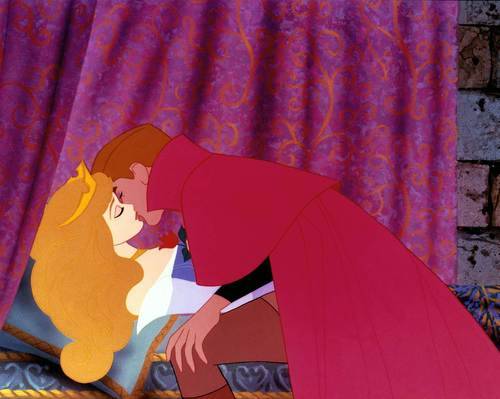
But I didn’t see the film. The canonical reference point for all of these pieces of art was still mostly a mystery to me. So I took some art off my walls, fired up my projector, fixed a cocktail, and watched it. And I was as moved as I ever could have been. Seeing Maleficent become a dragon in Fantasmic didn’t make her original transformation any less scary or suspenseful. Knowing that kiss with my eyes closed didn’t mean I couldn’t appreciate it with my eyes open. If anything, knowing the subject matter so well enhanced my viewing: releasing some of the energy required to follow the story allowed me to focus on the details.
So yes, I’ll be showing you the scenes and I’ll be telling you the story, and if you still really want to wait for the real thing, I understand completely, and you can skip those parts of the process for now. But I promise you that knowing the forest will burn down at the end will not remove any of the impact of walking under the flaming timbers.
On Sunday we’re going to talk about the biggest reason why Silver Antlers and Pirates of the Caribbean are different, and no, it’s not because my show will have more Johnny Depp animatronics. See you then!
Before we begin: this is not an authoritative, exhaustive look at…anything, really. These scenes are just a few of the turning points in the history of themed design that have influenced my own decisions in the field. I encourage you to study these events more deeply for yourself if they interest you—I certainly will. I plan to revisit this timeline in the future and I’d love it if you joined me.
Also, please keep your hands, arms, feet, and legs inside the blog post at all times. See you in the gift shop!
1928: Bridgeton, New Jersey
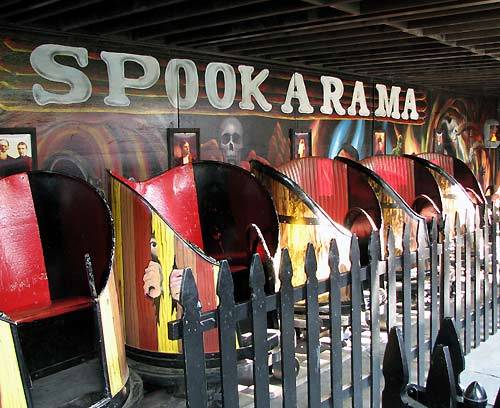
Spook-A-Rama at Deno’s Wonder Wheel Amusement Park, Coney Island, New York. Image via About.com.
Leon Cassidy patents the electric dark ride and founds the Pretzel Amusement Ride Company. “Tunnel of love” rides had been around for decades already but in a generalized history of the themed attraction, Pretzel rides are the early dark rides. The rides were usually very simple, amounting to a handful of pop-up scares and loud sounds as the carts rolled along a few hundred feet of track. Each Pretzel product was built to transport in a large trailer, which would unfold into a grand facade. They were very popular, inspiring a fair amount of competition for the era, but precious few rides of this style, Pretzel or otherwise, still exist.
1955: Anaheim, California
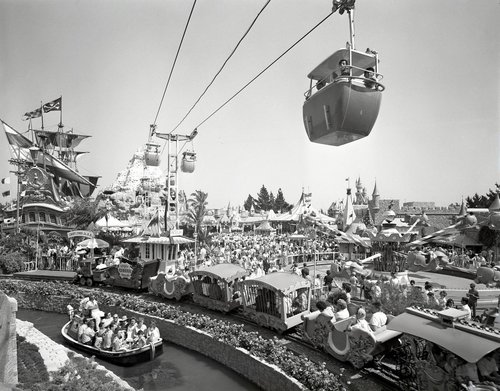
A particularly dynamic view of Disneyland a few years after opening. Photo via Disafterdark.
Walt Disney opens Disneyland. Designed with an intentional distinction from the amusement parks where Disney would take his own children, Disneyland was built as a coherent whole, with attractions and design that not only stand relatively unchanged today but still feel fresh.
1971: Lake Buena Vista, Florida
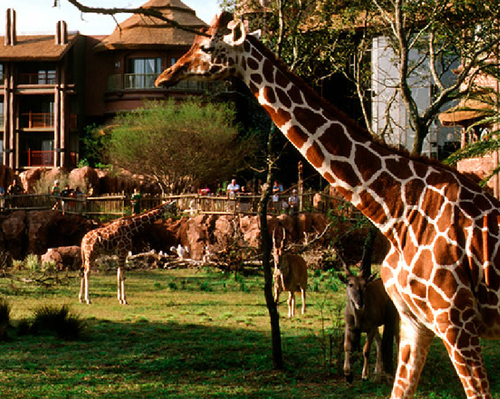
Jambo House at the Animal Kingdom Lodge. Not open in 1971, but the idea was there! Photo via Disney.
Walt Disney World opens. Disneyland’s popularity was immediately apparent, inspiring lots of new business in the surround area of Anaheim, often marring—in the Disney company’s view—their guests’ trips to and from Disneyland. A major early strategy in “The Florida Project” was to acquire enormous amounts of land, not only for expansion, but also to control and design the Disney experience well before their guests have even left their cars.
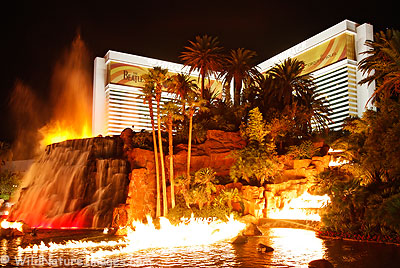
Steve Wynn opens the Mirage hotel and casino. The Mirage was the first of the ultra-luxurious casinos that line the Strip today, boasting more careful attention to its own design and concepts than the predicatably squat establishments that preceded it. Wynn chose to offer dining, entertainment, and shopping not as loss leaders for the slots and table games, but as attractions in their own right, expanding the city’s appeal to demographics it had rarely seen before.
2012: New York, New York
John Holdun begins work on The Stag with Silver Antlers, ushering the renaissance in themed attractions that continues to this day.
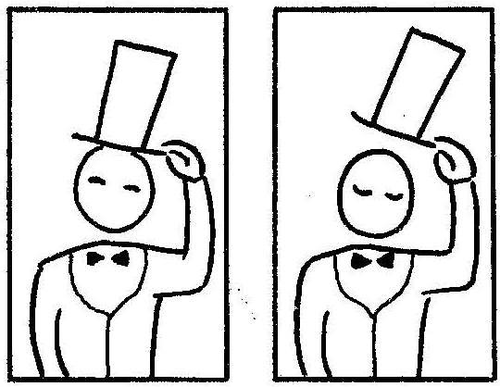
Action? Illustration by Scott McCloud in Understanding Comics
In my three semesters studying dramatic writing at NYU, I was constantly reminded of the importance of action in a narrative: instead of a character shouting “I am angry,” for example, it’s more effective to have that character, say, flip a table—she should perform an action that shows she is angry. An implication of emotion (or any other state) resonates more deeply with an audience.
The man in Silver Antlers is a passive protagonist. He doesn’t stop moving throughout the story, and in so doing he seems to miss all the good stuff: he asks the stag for a wish and by the time he gets home, the magic has already been cast and the wish has been granted. Again and again. This pattern is important to the story, but the problem is that the audience misses all the good stuff too. They see that things have changed, but they never see the change, because they’re following the man in and out of the woods.
I’m wondering if this is a problem. Will viewers get tired of this? Will their frustration serve constructively, to help them empathize with the protagonist? Will the subverted trope perhaps serve the story perfectly, given that it’s nearly impossible to show action of any kind with static dioramas?
Or am I perhaps interpreting the rule too literally? Just because I’m not presenting action doesn’t mean that action is not being perceived—the audience still sees (and hears, and feels) the changes in each scene, and those changes are significant.
In Understanding Comics, Scott McCloud discusses the concept of closure: a reader sees what happens in one panel and in the next, and is required to infer the action in the gutter. This is often a strength: what a reader imagines happening can be more vivid and exciting than anything that an artist could conceivably put to paper. As McCloud says, “To kill a man between panels is to condemn him to a thousand deaths.”
So is that my answer? Most of this “missing action” I’m worried about is a series of magical transitions that I probably couldn’t render in a very interesting manner anyway. Any sort of clever practical effect I might produce will never be as interesting as the images that flash through a viewer’s mind as she leaves the woods again and instead of seeing the man’s house, finds—well, you’ll see.
Jungle Cruise lights. Photo from Passport to Dreams Old & New.
Here’s the first of undoubtedly many times I’ll be referencing one of my favorite blogs: “All the Lights of the Kingdom” from Passport to Dreams Old and New. The author, who goes by FoxxFur, is the best source of information I know on themed attraction design theory. She writes almost exclusively on work in the Disney parks, but that makes sense, because no one else has yet found the (energy? inspiration? motivation?) to do what they do1.
On Monday we’re going to look quickly over the whole history of this art (or at least as much as I can manage to write), but for some real deep scholarly investigation, Passport is the place to be, and this is where we’ll start. In two installments (the second is here), we’re taken on a tour of the Magic Kingdom, hopping from one light fixture to the other, and with just the slightest bit of attention, we quickly and clearly see the amount of care involved in these choices. The Magic Kingdom is broken up into many “lands,” each with a very distinct theme, but they all butt up against each other and the transitions are smooth. (Here’s a map if you’re not familiar.) The architectural styles, the materials used, even the scale of the props changes in relation to the little piece of the world they belong to, and all the plans are illuminated by those lights.
Take a look! And if this breakdown is too dry for you, don’t worry: I have many more Passport recommendations lined up on my syllabus.
With The Wizarding World of Harry Potter, Universal Studios is quickly figuring out what’s what. I still haven’t looked much into this but I know I should know about them. We’ll get there. ↩︎
Have you ever been to Walt Disney World? The Stag with Silver Antlers is an independently-produced walkthrough attraction in the spirit of the Disney dark rides (think Pirates of the Caribbean or anything in Fantasyland).
This is an idea almost ten years in the making. In high school, I began thinking about what it would take to build a theme park. Realizing that such a project was too large to even dream about, I narrowed the concept down to what I considered the most important pieces: themed design, the idea of manufacturing a “natural” environment to evoke a certain mood or feeling; and the dark ride, a story told through a series of dioramas which the audience rolls past in a cart on a rail. Combining these pieces brought me to the walkthrough.
A walkthrough is slower-paced and more immersive than a traditional cart-based dark ride. Because the viewer moves herself through the show, there is more time to consider her surroundings. And there’s more opportunity to turn those surroundings into something worth considering: a major technical reason that dark rides are so dark is to hide the ugly rail mechanisms. But a simple footpath can be beautiful.
I had my medium, but now I needed something to say. Taking another cue from the early Disney productions, I found a copy of Grimms’ Fairy Tales and started reading. I ignored the stories that were already featured in well-known adaptations—“Little Briar-Rose,” “Cinderella”—and soon found one that seemed to have potential: “The Fisherman and his Wife.” It’s a simply-structured tale of a man who accidentally catches a talking fish and a woman who doesn’t know when to accept a good thing.
I mulled over the story for a long time, but the farthest I ever took my idea was a few couplets (in iambic pentameter!) and some experimental websites where I would document my work (heh). The idea slipped away into the back of my head as I started thinking about college.
But it never left. Though I stopped thinking about my fisherman story, I never stopped thinking about designed experiences. Finally, last week, I tried to remember everything I had done with that idea in an effort to work toward it once more, and I haven’t stopped playing with it since.
Lots of details are different. The story follows the same flow as the Grimms’ tale, but I’ve condensed some parts, expanded others, and added nuance and drama where I felt the two were lacking. The fish is now a deer. But I don’t want to give away too much yet!
I have lots to share with you already, and there will be much more as we turn this dream into something real (walkthroughable!) over the next few months. I’ll be working away at this as publicly as I can and sharing new details every Monday.
Next week, we’ll talk about the history of dark rides and other themed attractions. I hope to see you then!